
The traditional playbook is not dead. But the economics have changed, and the people who taught it have changed with them.
A few years ago, the standard advice for making money online fitted on a postcard. Pick a topic you care about. Build a site. Publish useful content. Earn affiliate commissions, ad income, or both. Add an email list. Repeat.
That advice built a lot of businesses, and it built IncomeDiary. Other routes ran alongside it: online courses, software, authority sites in tight niches, sponsorships. Michael Dunlop’s PopUpDomination is a good example from the software side. When Pat Flynn interviewed him on the Smart Passive Income podcast in October 2010, Michael had just launched it as a premium WordPress plugin for bloggers. It found one specific problem, getting more email subscribers, and built a tool for it.
So is that world over? Not quite. But anyone who tells you AI has changed nothing, or that it has changed everything, has not looked at the numbers.
1. Is blogging and affiliate marketing still viable?
The honest answer is: yes, but the easy version is gone.
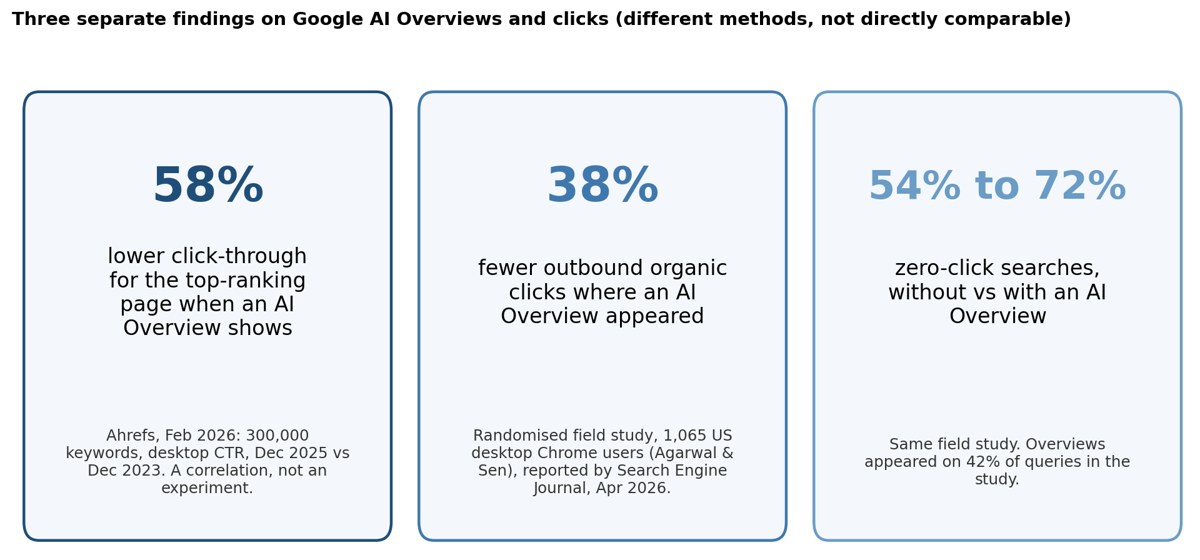
Start with the bad news, because it is well documented. Three findings are worth knowing. They come from different methods, so they should not be added together or compared like for like. Ahrefs looked at 300,000 keywords and found that an AI Overview goes with a 58% lower average click-through rate for the top-ranking page (December 2025 against December 2023, a correlation). A separate randomised field study of 1,065 US desktop Chrome users, reported by Search Engine Journal, found AI Overviews cut outbound organic clicks by 38% on the queries where they appeared. In that study, zero-click searches rose from 54% to 72%.
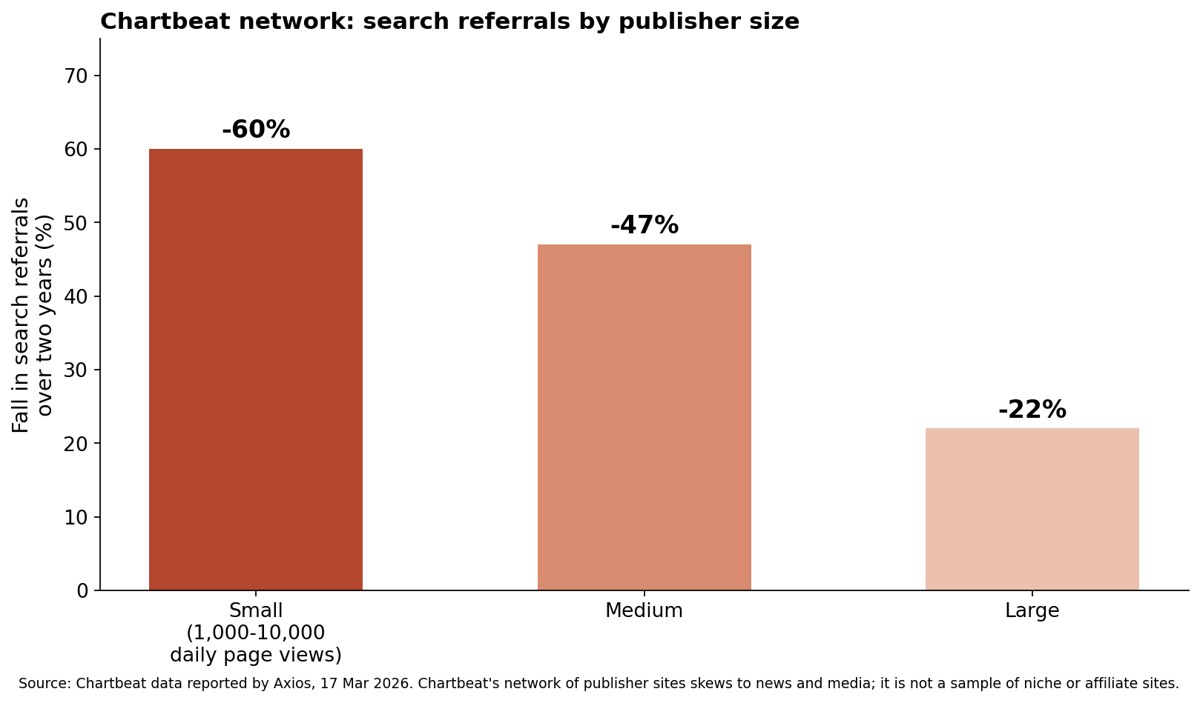
Publishers feel it too. Chartbeat data reported by Axios in March 2026 shows search referrals to small publishers (1,000 to 10,000 daily page views) down 60% over two years, against 47% for medium and 22% for large publishers. Chartbeat’s 2026 playbook puts the year-on-year fall in Google Search referrals across its network at 40.2%. Chartbeat’s network leans towards news and media. It is not a sample of niche or affiliate sites, so it shows the direction of travel rather than what any one site will see.
What is going out of fashion is the formula site: generic how-tos, thin product roundups, and rewritten versions of what is already on page one. AI can produce that kind of content cheaply, so it is much harder to stand out with it.
What holds up is what AI cannot easily fake. First-hand testing. Real photographs. A named person with a track record. An opinion. Data nobody else has. Those things also give readers a reason to come back without Google’s help, which is why audiences you own matter more than ever. Email platform beehiiv reports that paid subscription revenue on its platform rose from $8 million to $19 million in 2025 (a vendor’s own figures), and that its median free-to-paid conversion is only 0.62%. Newsletters can work, but slowly, and the stronger performers tend to have a sharp niche.
2. How the online business landscape has changed
The big change is not that new business models exist. It is that AI cut the cost of trying them.
AI has made it much quicker to build a first version of many things: a simple tool, a landing page, a course outline, a prototype. Gael Breton of Authority Hacker described, in a September 2026 podcast interview, going from an idea to a finished product in a weekend (his own account). A quick prototype is not a business, though. Customers, support and upkeep still take time.
That opens up a wider menu:
- Micro-SaaS and AI tools. Small products for one narrow job. Pieter Levels is the best-known solo example (see section 3). He is an outlier, and most small software products earn far less, so validate demand with paying customers before building much.
- Digital products, templates and courses. Cheaper to make than ever, which also means more competition. Standing out needs specific expertise, not just polish.
- Content businesses. YouTube, podcasts and newsletters. AI helps with research, editing and repurposing. It does not replace a recognisable voice.
- AI-assisted services. Automation setups, voice receptionists for trades, lead generation, and website work for local businesses (more on that below).
- Freelancing and specialist consulting. Deep knowledge of an industry, combined with AI for speed, is a strong mix.
- Niche sites, communities and memberships. Harder to copy than a blog, because the value is the people.
3. What happened to the established gurus?
Authority Hacker. Gael Breton and Mark Webster founded it in 2014. It became known for The Authority Site System (TASS), a beginner course on building affiliate content sites, and Authority Hacker Pro. On 17 December 2024 Breton posted on LinkedIn that they were closing both. His words: ‘SEO isn’t dead. But the content site model is.’ He said the Google updates, the flood of AI content and changes to the results pages had changed the game, that the two courses had generated eight figures in revenue, and that he would not sell courses teaching strategies that no longer work reliably for most people. Today the authorityhacker.com homepage leads with an AI Accelerator membership aimed at business owners, a free Claude Code course and the podcast. It does not feature the old courses. The site claims 15,000+ paid customers, 80,000+ email subscribers and 3M+ podcast downloads over its history. Those are the company’s own figures.
In that September 2026 interview, Breton said he had stopped the SEO business and gone all-in on AI, and the show notes say the new training business has over 1,000 members. His message on that show is that AI amplifies what you already know rather than filling gaps, and that website builders and design agencies are in real trouble. That last point matters for the website-refresh example below. The shift itself is the lesson: the founders closed a successful course business because the model underneath it stopped working, and moved to where they saw demand.
Neil Patel. Patel’s agency, NP Digital, operates in around 28 countries. He has moved his message from classic SEO towards what he calls AEO and GEO, which means getting your brand mentioned by ChatGPT, Gemini, Perplexity and Google’s AI answers. His Ubersuggest tool now has an AI Visibility Report showing where a brand appears across large language models. NP Digital Australia reported 25% revenue growth in the second half of 2025 and said demand for AI-led performance marketing was driving it.
What is most useful is how Patel talks about AI. In an April 2026 interview he said that when he asks rooms of marketers whether AI has increased their revenue, only 2% to 3% raise their hands. He also warned against ranking for flattering keywords that bring no buyers. His lesson for smaller players is plain: use AI where it moves revenue, measure it, and ignore the rest.
Pieter Levels. The solo founder behind products such as Nomad List and Photo AI wrote in September 2026 that his business revenue has stayed at roughly $200,000 to $250,000 a month (his own figure, unaudited) and that he has cut his software dependencies by building his own replacements with AI. He is an outlier, not a benchmark, but he shows what one person with a handful of focused products can now run.
4. Practical examples of making money online today
The best practical ideas share a pattern: a specific customer, a clear problem, AI doing the slow parts, and a human supplying judgment and trust. The three examples below are illustrations of that pattern. They are not case studies, and they come with no earnings figures. What they cost, how much work they take and how to test them is what matters.
Example A: show-first website refresh for local businesses
One entrepreneur is reported to use this approach: find local businesses whose websites are dated or hard to use, send a personal message, build a quick AI-generated concept of a better site before the meeting, then show it to the owner. Anecdotal accounts of it circulate online, and results vary. This article does not rely on any particular conversion rate, so test it on a small scale before building a business around it.
The principle is sound: show, don’t tell. A draft of someone’s own site is more persuasive than a pitch deck. Here is how it might look in practice.
- What you do: pick one type of business in one area, for example dentists or electricians. Check ten to twenty websites by hand. Write each message yourself. Build a short concept for the few that look like a good fit. Meet the owner, listen, then quote.
- What it costs: a few AI and website-builder subscriptions, a domain or two, and your time. The main cost is hours, mostly on research and on following up.
- What to validate first: do owners reply at all? Do any agree to a meeting? Do any pay? Count meetings against the number of businesses you contacted, not only against meetings held. Meetings are a narrower group than everyone you contacted, so a strong result among meetings can sit alongside a much lower share of all prospects becoming clients.
- Risks: site building is the easy part and is getting easier for everyone, including the business owner, so the lasting value is in what comes after: updates, local search, booking and enquiry handling. Cold email and data-protection rules differ between countries and between sole traders and companies, so check the rules where you and your prospects are based. Be open that the concept is a draft, and do not use a business’s logo or images in a way it has not agreed to.
Example B: missed-call handling for a trade business
Many small trade businesses cannot answer the phone while they are on a job. An illustrative service: set up an AI-assisted phone or text-back system for one trade, so enquiries are captured and a job can be booked.
- What you do: choose one trade, learn how its jobs are quoted and booked, set up the call-handling tool, test it with real calls, and review transcripts regularly.
- What it costs: software subscriptions, call or message charges, and your setup and monitoring time. Work out whether the monthly fee you would charge covers the tool costs plus your support time.
- What to validate first: ask two or three business owners how many calls they miss and what a typical job is worth, then run a short paid or free pilot and compare booked jobs before and after.
- Risks: you depend on third-party platforms whose prices and rules can change. Call recording and consent rules vary by country. A system that answers badly can cost a client a customer, so keep a human fallback.
Example C: a paid community or newsletter for a profession you know
This is the audience-led route, and it is closest to what Authority Hacker now does: a membership built on practical, tested know-how for a defined group. An illustration: an experienced estimator, bookkeeper or electrician starts a paid newsletter or community for people entering that trade, using AI to speed up research, editing and templates.
- What you do: publish useful free material for a few months, collect email addresses, talk to readers, then offer a paid tier or community for those who want more.
- What it costs: a newsletter or community platform, possibly a small design budget, and a regular time commitment. It is slow to build.
- What to validate first: whether readers open and reply, and whether even a small group will pay for a defined benefit. Conversion from free to paid is usually low, so plan for that.
- Risks: it depends on your own reputation and consistency. AI-written filler will not hold a paying audience, so personal experience has to be the core.
5. The new rules
- Problem first, tool second. Everyone has the same AI. Few people have a clear view of a specific customer’s pain.
- Speed is an advantage. You can test an idea in days. Do it cheaply, then drop what fails.
- Distribution is the moat. Customers, audience and trust are harder to copy than software. Own a list, a community or a reputation.
- Small teams can do more. One person can now run what used to need a team. That also means more small competitors.
- Keep improving. A tip that was clever a year ago is basic now, as Breton put it. Product lifespans are shorter. Plan for continuous change.
- Use what you already know. Industry contacts and years of experience, combined with AI, beat generic effort.
- Combine the three. The strongest businesses tend to mix audience, service and product: a following that finds you clients, a service that teaches you what to build, a product that scales it.
The principles of entrepreneurship have not moved. Find a real problem, reach the people who have it, be trusted, keep improving. What has changed is how little it costs to try.
6. The best opportunities for 2026 and 2027
This part is judgement, not history. Nobody knows how 2027 will play out, so treat these as reasoned bets.
Beginners with little money. Sell a service to local businesses, using AI to do the work faster. Start with one niche in one town. It can pay within weeks, and clients teach you what to improve. Expect rejection and hard work. A realistic first target is a few clients, not a fortune.
Experienced marketers, bloggers and creators. Move from search-only traffic to an audience you own. Keep your best content, add personal experience and original data, and build a newsletter or community. Test showing up in AI answers, but do not rely on it, as nobody can yet promise results.
Technical people and developers. Micro-SaaS for a narrow professional problem, or tools that plug AI into a workflow people already pay for. The data suggests many products earn little, so validate with paying customers before building much.
People who prefer services. Automation, lead generation and specialist consulting in an industry you know. Pricing by outcome and ongoing support beats one-off builds.
Businesses that could last. The ones that combine an audience, a service and a product, and own their customer relationships. Short-lived side hustles are the ones that depend on a single platform, trick or tool.
The honest warning. Be careful with promises of passive income. Almost everything here needs steady work. Earnings figures online are often self-reported, and the people who publish numbers are usually the ones with good ones. Start small, check claims for yourself, and be wary of any course that sells a guaranteed result, including courses about AI.
Three things to do this week: pick one problem you understand; talk to five people who have it; build the smallest thing that solves it with AI and show it to them.
The post Making Money Online in the Age of AI: What Still Works in 2026 and 2027 appeared first on How To Make Money Online.
See TessMore Internet Business Must-Reads ||How To Make Money Online https://ift.tt/NzWFPfR
Comments
Post a Comment