Quick Reference: 7 Qualitative Research Methods
| Method | Best For | Cost | Environment | Key Advantage |
|---|---|---|---|---|
| Individual Interviews | Deep one-on-one insights | Low-Medium | Phone, video, or in-person | Flexibility to dig deeper with follow-ups |
| Focus Groups | Group dynamics & idea generation | Medium-High | In-person | See verbal/non-verbal reactions, ideas bounce off each other |
| Shop-Alongs | Real shopping behavior | Medium | Retail store | Observe actual behavior vs. claimed behavior |
| In-Home Videos | Natural product usage | Medium | User’s home | Authentic behavior in comfortable setting |
| Lifestyle Immersion | Unfiltered attitudes & behaviors | Low-Medium | Events, gatherings | Candid insights in familiar settings |
| Journals/Diaries | Ongoing experiences over time | Low | User’s choice | Capture authentic voice for marketing copy |
| Online Focus Groups | Broad reach, budget-friendly | Low | Social media/online | Cost-efficient, larger participant pool |
Are you conducting market research? Qualitative research is an important first step in the market research process. In this guide, we’ll share 7 qualitative research methods for understanding your user.
Qualitative research is important for gaining a broad understanding of the underlying reasons and motivations behind consumer decisions.
We’ll share the qualitative research methods in just a moment, but before we dive in, let’s briefly discuss the basics.
What is Qualitative Market Research?
Qualitative market research is any research conducted using observation or unstructured questioning.
While quantitative research answers the what, where, when and who of decision making, qualitative research also answers the why and how.
Qualitative vs. Quantitative Research
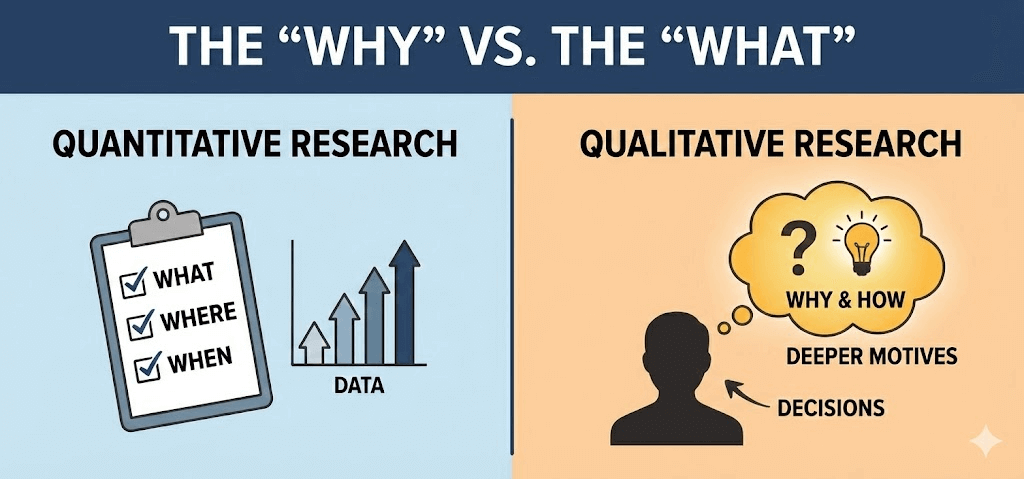
The goal of qualitative research is to gain insights into the deeper motives behind consumer purchases.
The goal of quantitative research, on the other hand, is to quantify and generalize the results so that the marketer can come to a final conclusion about the best course of action.
Why use qualitative research as opposed to quantitative research?
Well, first of all, qualitative research should not be used instead of quantitative research. The two are complementary to each other.
Qualitative research in and of itself is not conclusive. However, it is used to…
- Explain quantitative research results
- Conduct market research when traditional surveys are not available (e.g. with embarrassing or “touchy” questions)
- Conduct market research when more structured research is not possible
Qualitative research is a good first step to take when conducting your market research. Are you ready to learn how?
Great! Let’s dive into the 7 qualitative research techniques.
1. Individual Interviews

An individual interview can be conducted over the phone, Skype, or in person. The idea is to ask your ideal user (or an existing customer) a series of questions and follow-ups to learn what motivates them to buy a product like yours.
You should go into the interview with some questions prepared ahead of time, but don’t feel like you need to stick to a script. If they say something interesting, ask followup questions that dig deeper. Really try to put yourself in their shoes, and try to figure out what makes them tick.
Here are a few initial questions you could ask:
- What frustrates you in regard to [your topic]?
- If I had a magic wand and could give you anything you want, what do you most desire?
- What do you lose sleep over at night?
- Have you bought [your type of product] before?
- If so, what motivated you to buy it?
2. Focus Groups

Focus groups are generally conducted in-person. These groups are meant to provide a safe and comfortable environment for your users to talk about their thoughts and feelings surrounding your product.
The advantage of using in-person focus groups is that you get to see the consumer’s verbal and non-verbal reaction to your product or advertising. The other advantage is that the different members of the group can bounce off each other’s thoughts and ideas, which means you’ll get even greater insights.
You can use focus groups to:
- Test product usage or tasting
- Explore the general concept for your product
- Evaluate your advertising copy and imagery
- Explore new packaging ideas
3. Observations or “Shop-Alongs”

An in-person observation of shopping behavior (or a “shop-along”) allows you to actually watch the consumer react to your product in-store. This way, you get to see their actual shopping behavior, as opposed to just what they would claim on a written survey.
One way that this is useful is by highlighting challenges that arise from shelf display issues, clutter, or out of stock issues. You may also interact with consumers to get deeper insights during the shopping process, to get feedback on package design, for example.
4. In-Home Videos

In-home videos allow you to observe how users interact with your product in real life, at home.
The advantage of this method is that you get to observe user behavior in a natural, comfortable environment. This way, they can feel free to simply be themselves, and you’ll get a more realistic view of how your product is being used.
5. Lifestyle Immersion and Real World Dialogue

Lifestyle immersion is when you attend an event, such as a party or a family gathering. This allows you to get an uninterrupted view of your user’s attitudes and behaviors. This is another great way to get candid insight in a comfortable, familiar setting.
During these activities, observe your users having a dialogue with their friends. Listening in to real-world conversations is a really powerful way to get a deeper understanding of their desires, frustrations, and motivations.
6. Journal or Diary

Have your user (or potential user) keep a journal or a diary to document their experience with your topic or your product.
This can be handwritten or digital. Either way, it will allow you to capture your user’s actual voice, which is extremely valuable for marketing copy.
7. Online Focus Groups

Online focus groups are similar to in-person focus groups, except that they are more cost-efficient and allow you to reach more people.
Use social media to your advantage by creating communities of people who are interested in your topic, and fostering a conversation. Then, simply observe the dialogue. You’ll gain a lot of interesting insights!
How to Analyze Qualitative Data
At this point you may be wondering, how do you actually analyze qualitative data after you’ve gathered it?
Since qualitative data is unstructured, it can be tricky to draw conclusions from it, let alone present your findings. While it is not meant to be conclusive in and of itself, here are a few tips for analyzing qualitative research data.
Top Tools Alert: 5 Best Survey Data Visualization Tools (In-Depth Comparison)
- Summarize the Key Points
For interviews and focus groups, have the moderator write up some key points that they heard. For example: “Common concerns among participants in regard to our pizza were cheese overuse, greasiness, and bland sauce.”
- Code Responses
“Code” the unstructured data into something that can be summarized with tables or charts. For example, some coded responses to the question “When do you wear a watch?” might be 1—never, 2—once in a while, 3—everyday, etc.
- Create a Word Cloud
Create a “word cloud” out of the keywords being used by the consumer. Just take your notes and put them into a word cloud generator, such as WordClouds.com. Then you’ll be able to easily spot the most prominent words.
That’s it! We shared 7 qualitative research methods that you can use to better understand your user or target customer. To get the most out of your online surveys, check out our survey best practices.
Now it’s your turn. Go ahead and begin your market research by trying one of the techniques above.
Once you have a clear understanding of your customers, then follow this step-by-step guide to using email marketing to generate consistent leads and sales for your business.
Frequently Asked Questions
What is qualitative research in market research?
Qualitative research is a method that uses observation and unstructured questioning to understand the underlying reasons, motivations, and emotions behind consumer behavior. Unlike quantitative research that answers “what” and “how many,” qualitative research answers “why” and “how” customers make decisions.
What’s the difference between qualitative and quantitative research?
Qualitative research explores deeper motivations through methods like interviews and focus groups, providing rich insights but not statistical conclusions. Quantitative research uses surveys and numerical data to measure and generalize results across larger populations. They’re complementary—qualitative research typically comes first to inform quantitative studies.
When should I use qualitative research methods?
Use qualitative research when you need to: (1) explore motivations before running large surveys, (2) explain unexpected quantitative results, (3) research sensitive topics where traditional surveys won’t work, or (4) gather authentic customer language for marketing copy. It’s ideal as a first step in market research.
What is the best qualitative research method for small budgets?
Individual interviews and online focus groups are the most budget-friendly options. Individual interviews can be conducted via phone or video call at minimal cost, while online focus groups leverage social media communities you may already have, eliminating venue and travel expenses.
How do you analyze qualitative research data?
Analyze qualitative data by: (1) summarizing key themes the moderator heard, (2) coding unstructured responses into categories that can be charted, and (3) creating word clouds to identify frequently used terms. While qualitative data isn’t statistically conclusive, these methods help identify patterns and customer language.
How many people do you need for qualitative research?
Sample sizes vary by method: individual interviews typically need 5-15 participants to identify patterns, focus groups work well with 6-10 people per session (run 3-4 sessions), and online communities can include dozens or hundreds. Quality matters more than quantity—seek depth of insight over statistical representation.
Comments
Post a Comment